









Categories
  • FILTRO Family
    FILTRO Family

    FILTRO Family


    Everything about drinking water: laws, parameters and maximum allowable values

    Discover the essential parameters of drinking water, according to Law 458/2002 and Law 311/2004. Find out the maximum allowable values for microbiological, chemical parameters and indicators.

    Water is found in nature in many forms and with a multitude of organic or inorganic substances dissolved in it or in suspension. Depending on these substances in the water, it can be declared potable or non-potable.

    In Romania there are 2 laws that regulate water quality. In this article we will summarize these laws and display the complete list of drinking water parameters and maximum allowable values according to current legislation.

    The drinking water laws are as follows:

    1. Law no. 458 of July 8, 2002 on the quality of drinking water.
    2. Law no. 311 of June 28, 2004 for the amendment and completion of Law no. 458/2002 on the quality of drinking water.

    In these laws, drinking water is defined as water intended for human consumption, as follows:
    a) any type of water in its natural state or after treatment, used for drinking, food preparation, or other domestic purposes, regardless of its origin and regardless of whether it is supplied through a distribution network, from a reservoir, or distributed in bottles or other containers;
    b) all types of water used as a source in the food industry for the manufacture, processing, preservation or marketing of products or substances intended for human consumption.
    c) water from local sources, such as wells, springs, etc., used for drinking, cooking or other domestic purposes.

    Drinking water must be wholesome and clean, meeting the following conditions:
    a) to be free of microorganisms, parasites or substances which, by their number or concentration, may constitute a potential risk to human health;
    b) to meet the minimum requirements set out in the law.

    The quality parameters of drinking water are of 3 types: microbiological, chemical and indicators. Below we have extracted from the 2 laws all the parameters and maximum allowable values.

    Microbiological parameters

    Parameter Max. allowable value
    Escherichia coli 0/100 ml
    Enterococci 0/100 ml

    Microbiological parameters for water sold in bottles or other containers

    Parameter Max. allowable value
    Escherichia coli 0/250 ml
    Enterococci 0/250 ml
    Pseudomonas aeruginosa 0/250 ml
    Colony count at 22 degrees C 100/ml
    Colony count at 37 degrees C 20/ml

    Chemical parameters

    Parameter Max. allowable value
    Acrylamide 0.1 µg/l
    Arsenic 10 µg/l
    Benzene 1.0 µg/l
    Benzo(a)pyrene 0.01 µg/l
    Boron 1.0 µg/l
    Bromates 10 µg/l
    Cadmium 5 µg/l
    Vinyl chloride 0.50 µg/l
    Total cyanides 50 µg/l
    Free cyanides 10 µg/l
    Total chromium 50 µg/l
    Copper 0.1 mg/l
    Dichloroethane 3.0 µg/l
    Epichlorohydrin 0.1 µg/l
    Fluoride 1.2 µg/l
    Mercury 1.0 µg/l
    Nickel 20 µg/l
    Nitrates 50 mg/l
    Nitrites 0.50 mg/l
    Lead 10 µg/l
    Selenium 10 µg/l
    Antimony 5.0 µg/l
    Tetrachloroethylene and Trichloroethylene (sum of concentrations of specified compounds) 10 µg/l
    Polycyclic aromatic hydrocarbons: benzofluoranthene, benzopyrene, indenopyrene 0.1 µg/l
    Pesticides of the aldrin, dieldrin, heptachlor and heptachlor epoxide class 0.1 µg/l
    Total pesticides 0.5 µg/l
    Total trihalomethanes (sum of concentrations of specified compounds) 100 µg/l

    Indicator parameters

    Parameter Max. allowable value
    Aluminium 200 µg/l
    Ammonium 0.5 mg/l
    Coliform bacteria 0/100 ml
    Total organic carbon No abnormal change
    Chlorides 250 mg/l
    Clostridium perfringens 0/100 ml
    Free residual chlorine 0.5 mg/l at network entry, 0.25 mg/l at network exit
    Conductivity 2500 µS/cm at 20 degrees C
    Colour Acceptable to consumers and no abnormal change
    Total hardness Minimum 5 German degrees
    Iron 200 µg/l
    Manganese 50 µg/l
    Zinc 5000 µg/l
    Sulphides and hydrogen sulphide 100 µg/l
    Turbidity 5 NTU
    Oxidisability 5.0 mg O/l
    pH Between 6.5 and 9.5
    Sodium 200 mg/l
    Sulphate 250 mg/l
    Taste Acceptable to consumers and no abnormal change
    Colony count at 22 degrees C No abnormal change
    Odour Acceptable to consumers and no abnormal change
    Total alpha activity 0.1 Bq/l
    Total indicative dose 0.10 mSv/year
    Total beta activity 1.0 Bq/l
    Tritium 100 Bq/l

    The values presented in this study are those regulated by law. Water from the public network must mandatorily fall within these values. However, in most cases the water leaves the public network as potable, but becomes contaminated because the pipes through which it reaches the population are old and deteriorated.

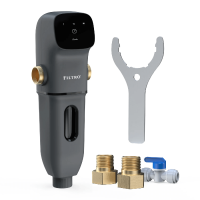
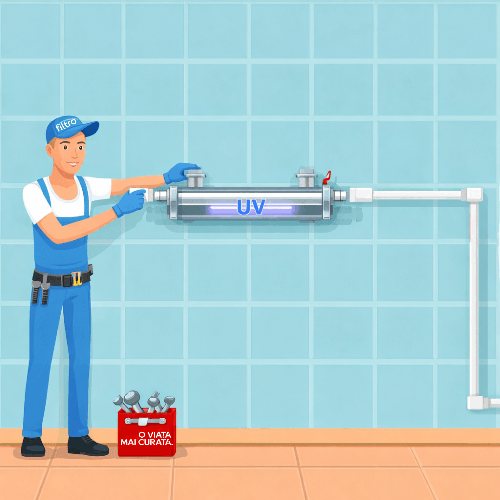
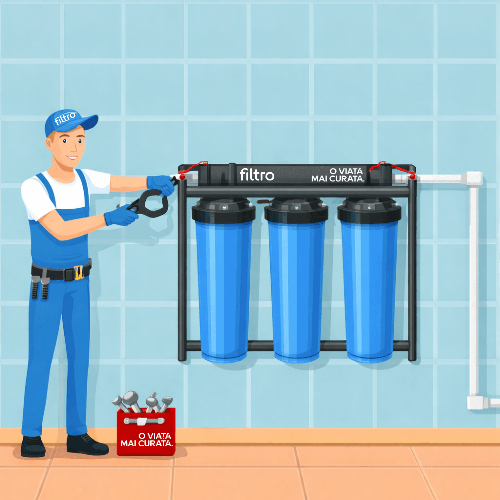
    Although water from the public network is delivered as potable, it becomes contaminated along the way (sand, rust, sediment, bacteria, etc.). In order to consume this water, we recommend installing a water filter. For tap water, to make it drinkable, you need a classic filtration system containing at least a sediment cartridge (5 microns) and an activated carbon cartridge (block or granular). This way you will successfully filter sand, rust and other sediments, and also remove chlorine and its by-products. In addition, you can add other cartridges to reduce hardness, eliminate bacteria or improve water quality.

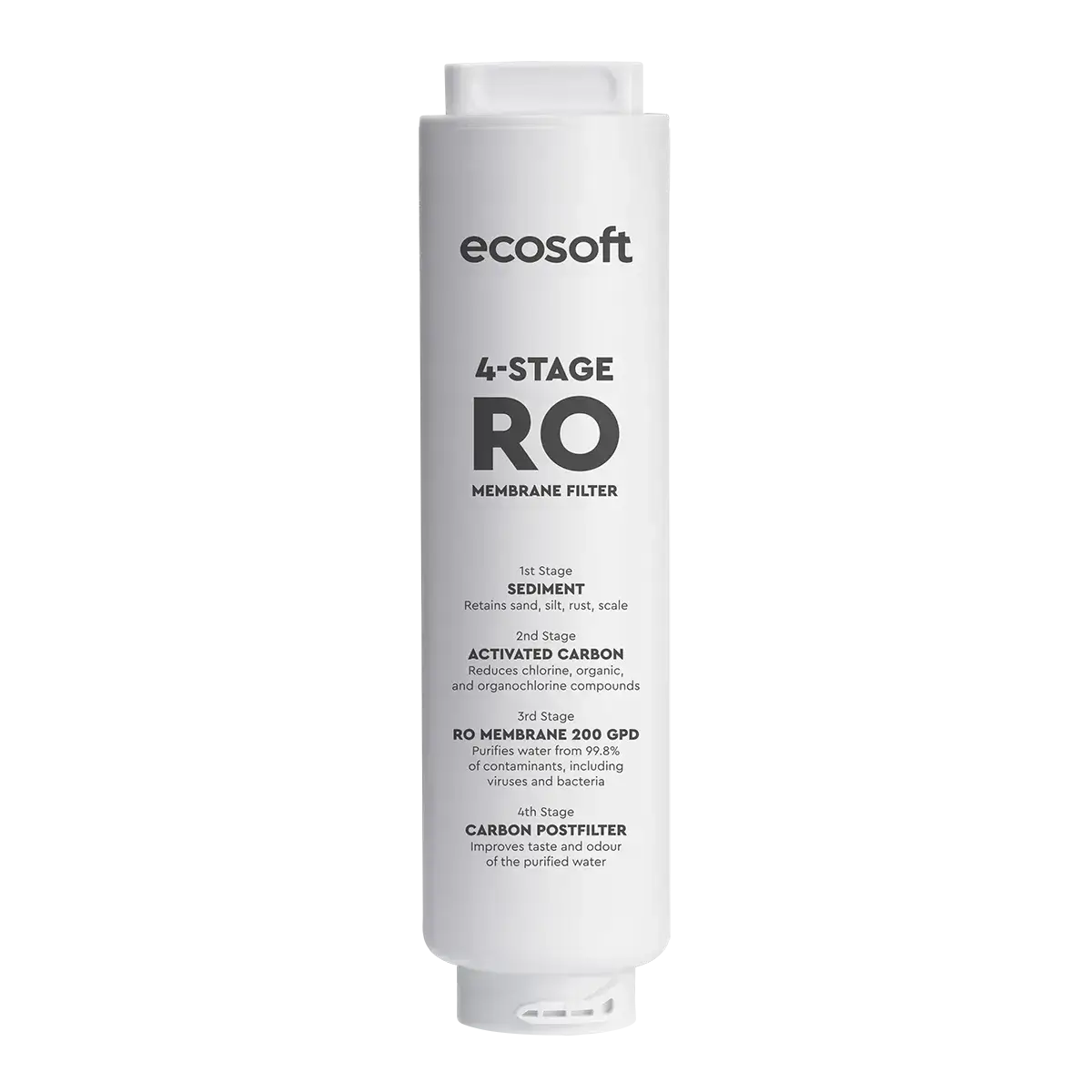
    If you have water from a well or a spring, since it is not treated and periodically monitored, we recommend installing a reverse osmosis system. This is the only solution that guarantees potable water regardless of the contaminants in the input water. Being a molecular filtration process, it removes 98% of chemical and microbiological contaminants from the water.

    For some time now, a water filter has become indispensable in our homes. You save money and time, have the guarantee of clean water and enjoy greater comfort (no more carrying water and always having good water available). In terms of utility, it is similar to a refrigerator or a washing machine. Think about how you would manage without a washing machine. It would be difficult, wouldn't it? Once you have a water filter at home, you will never want to give it up. FILTRO offers you quality equipment for a cleaner life.

    Featured products

    Recommended products for a cleaner life

      + Gift

    Your browsing history

    Roata REDUCERILOR!

    Încearcă-ți norocul și poți câștiga reduceri (până la 50%) sau premii în produse.

    * Prin abonare ești de acord cu termenii site-ului și politica de confidențialitate.